
Hair conditioner is an essential part of a complete hair care routine because it helps improve softness, reduce tangling, smooth the hair surface, and make hair easier to manage. Knowing how to use hair conditioner correctly can help you achieve better results, whether your hair is straight, curly, fine, thick, dry, oily, or color-treated.
The best way to use most rinse-out conditioners is to apply them after shampooing, distribute the product evenly through the appropriate sections of your hair, leave it on for the recommended time, and rinse thoroughly. However, different conditioner formulas have different purposes, so understanding the instructions on the product label is important.
Many people have questions about hair conditioning, including how is hair conditioner used, how long to leave conditioner in hair, and how to put conditioner on hair without making it greasy. Others want to know, can I add conditioner to my hair dye, or whether conditioner can help with frizz, dryness, and hair breakage.
This comprehensive guide explains the correct application method, the differences between conditioner types, common mistakes to avoid, and practical ways to choose a product that suits your hair care needs.
What Is Hair Conditioner and How Does It Work?
Hair conditioner is a cosmetic hair care product designed to improve the feel, appearance, and manageability of hair. It commonly contains conditioning agents, emollients, and other ingredients that help reduce friction between hair strands and smooth the outer surface of the hair. Hair can become rough, tangled, or difficult to manage because of washing, heat styling, chemical treatments, environmental exposure, and everyday brushing. Conditioner helps reduce these effects by making the hair easier to comb and less prone to friction-related damage. Unlike shampoo, which is primarily formulated to clean the scalp and hair, conditioner focuses on improving the condition of the hair fibers.
Depending on its formulation, a conditioner may help:
- Make hair feel softer and smoother.
- Reduce tangling during combing.
- Improve shine and manageability.
- Reduce friction between individual hair strands.
- Make dry or damaged hair easier to style.
- Help control the appearance of frizz.
- Support the cosmetic care of color-treated hair.
However, conditioner does not permanently repair split ends, reverse every type of hair damage, or treat the underlying causes of hair loss. Its benefits are mainly cosmetic and depend on the product formulation and the condition of your hair.
How Is Hair Conditioner Used?
Hair conditioner is generally used after shampooing. Shampoo removes dirt, excess oil, sweat, and styling-product residue, while conditioner helps smooth the hair and improve manageability.
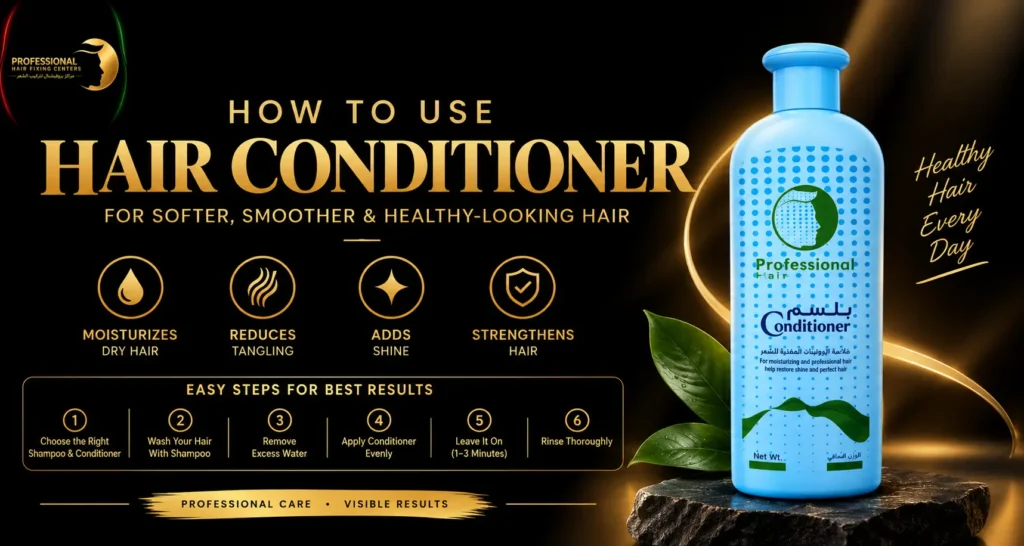
For most standard rinse-out conditioners, follow these six steps.
Step 1: Choose the Right Shampoo and Conditioner
Start by selecting products suitable for your scalp and hair type. For example, dry hair may benefit from a richer conditioning formula, while fine hair may respond better to a lightweight conditioner.
If your hair is colored, chemically treated, or frequently exposed to heat styling, consider products formulated for those needs. You do not necessarily need the most expensive conditioner. The important factors are the formulation, your hair’s response, and whether the product meets your specific requirements.
Step 2: Wash Your Hair With Shampoo
Wet your hair thoroughly with lukewarm water. Apply shampoo according to its instructions, concentrating on the scalp where oil, sweat, and residue typically accumulate. Massage gently using your fingertips rather than scratching the scalp with your nails. Rinse thoroughly to remove the shampoo. If you have particularly oily hair or significant product buildup, your shampooing routine may need adjustment. Avoid repeatedly washing your hair unnecessarily, especially if it leaves your scalp feeling dry or irritated.
Step 3: Remove Excess Water
After rinsing the shampoo, gently squeeze excess water from your hair.
Your hair should remain damp, but removing excess water can make it easier to distribute conditioner without immediately diluting the product. Avoid twisting, pulling, or aggressively rubbing your hair with a towel. Gentle handling helps reduce mechanical stress, particularly when hair is wet.
Step 4: Apply Conditioner Evenly
Dispense a suitable amount of conditioner into your palm. Start with a small quantity and increase it if necessary. Spread the conditioner through the mid-lengths and ends of your hair, unless the label recommends a different application method. These areas often experience more friction, tangling, and dryness than the roots. If your hair is long or thick, divide it into sections to help distribute the product evenly.
Step 5: Leave the Conditioner on Your Hair
Allow the conditioner to remain in your hair for the period specified on the label. Many regular rinse-out conditioners are used for approximately one to three minutes, although the recommended time varies by formula. Deep conditioners and hair masks may require longer application times. Do not assume that leaving every conditioner on for an extended period will improve the results.
Step 6: Rinse Thoroughly
Rinse your hair with lukewarm water until the rinse-out conditioner has been removed according to the product instructions. After rinsing, gently squeeze out excess water and style your hair as usual. If you are using a leave-in conditioner, follow its instructions instead of rinsing it out.
How to Put Conditioner on Hair Correctly
Understanding how to put conditioner on hair is important because the amount, placement, and distribution of the product can affect how your hair feels after washing.
For most standard conditioners, the mid-lengths and ends are the best starting point.
Apply Conditioner to the Mid-Lengths and Ends
Begin applying conditioner a short distance away from the roots and continue toward the ends.
The ends of your hair are the oldest sections of each strand and may have experienced more washing, brushing, heat exposure, and chemical processing. Conditioning these areas can help improve smoothness and reduce tangling.
If your hair is very short, use a smaller quantity and distribute it according to the product instructions.
Use Your Fingers to Distribute the Product
Your fingers can help spread conditioner evenly through the hair.
For long, thick, or curly hair, gently separate the hair into sections. Work through each section rather than applying all the product to one area.
If you use a wide-tooth comb, move slowly and avoid pulling through stubborn knots.
Adjust the Amount According to Your Hair Type
The amount of conditioner required varies from person to person.
Fine or short hair may need only a small amount, while long, thick, or highly textured hair may require more product.
Applying excessive conditioner can make some hair types feel heavy or coated. Start with less and add more only when necessary.
Should You Apply Conditioner to Your Scalp?
Most regular rinse-out conditioners are intended primarily for the hair lengths and ends. Applying too much near the roots may make fine or oily hair appear flat.
However, some conditioners are specifically formulated for scalp application. Follow the instructions for your particular product rather than assuming every conditioner should be applied in the same way.
If a product causes itching, burning, redness, or persistent irritation, discontinue use and seek appropriate professional advice if symptoms continue.
How Long to Leave Conditioner in Hair?
How long to leave conditioner in hair depends on the type of conditioner you are using. Regular rinse-out conditioners, deep conditioners, hair masks, and leave-in conditioners are designed for different purposes.
The following table provides general guidance.
Conditioner type | Typical application guidance |
Regular rinse-out conditioner | Often around 1–3 minutes, or as directed |
Deep conditioner | Commonly around 5–20 minutes, depending on the formula |
Hair mask | Follow the product’s recommended treatment time |
Leave-in conditioner | Leave in without rinsing, as directed |
Specialty conditioning treatment | Follow the manufacturer’s instructions |
These times are general examples, not universal rules. Some products have different application requirements.
What Happens If You Rinse Conditioner Out Too Quickly?
Rinsing a conditioner out before its recommended application time may reduce the intended conditioning effect.
However, this does not mean that every conditioner needs to remain in the hair for several minutes. Some formulas are designed to work quickly.
Follow the instructions on the packaging to get the intended results.
Can You Leave Conditioner in Your Hair Overnight?
You should not leave an ordinary rinse-out conditioner in your hair overnight unless the manufacturer specifically states that it is suitable for extended use.
Rinse-out conditioners are not necessarily formulated to remain in contact with the hair and scalp for many hours. Leaving them in may cause buildup or irritation in some people.
If you want overnight conditioning, choose a product specifically designed for overnight use or leave-in application.
Does Leaving Conditioner in Longer Make Hair Softer?
Not necessarily. Once a conditioner has been used according to its instructions, additional application time may not provide further benefits.
Using the wrong formula or leaving excessive product in the hair can sometimes make it feel heavy or coated.
The product’s formulation, your hair type, and correct application are more important than simply extending the treatment time.
Can I Add Conditioner to My Hair Dye?
A common hair coloring question is, “Can I add conditioner to my hair dye?”
The safest general advice is not to mix conditioner directly into hair dye unless the manufacturer specifically permits it.
Hair dyes are formulated using particular ingredients and proportions to achieve their intended coloring results. Adding conditioner can change the formulation, particularly when permanent color or developer-based products are involved.
The outcome may include uneven color, reduced coverage, unpredictable results, or interference with the intended coloring process.
Can You Mix Conditioner With Permanent Hair Dye?
Do not add conditioner to permanent hair dye or its developer unless the manufacturer’s instructions explicitly allow it.
Permanent hair color products depend on their intended formulation and mixing ratios. Changing those ratios may affect how the product performs.
If you want a lighter color result, a softer shade, or less intense coverage, select a product designed to achieve that result instead of changing the formula yourself.
Can You Mix Conditioner With Semi-Permanent Hair Dye?
Some semi-permanent direct dyes can be diluted with conditioner to create a softer or more pastel-looking shade. However, this depends on the specific product.
Not all products described as semi-permanent use the same chemistry. Some may contain ingredients that require a particular application method.
Before mixing anything, read the manufacturer’s instructions and check whether dilution with conditioner is permitted.
Can Conditioner Be Used After Hair Coloring?
Yes. A suitable conditioner can help improve the feel and manageability of color-treated hair.
Follow the coloring product’s instructions, including any directions about rinsing, conditioning, and when to shampoo again.
Products designed for color-treated hair may help reduce dryness and improve softness, but they cannot guarantee that color will never fade.
What Is the Best Way to Get a Softer Hair Color?
If you want a less intense hair color, consider a product specifically designed for a softer shade or consult a qualified hair color professional.
Avoid experimenting with permanent dye and developer ratios. Always follow the product instructions and complete the recommended allergy alert test before coloring.
What Are the Different Types of Hair Conditioner?
Choosing the right type of conditioner is just as important as learning how to apply it. Different products are designed to provide everyday conditioning, extra moisture, detangling support, or specific styling benefits.
1. Regular Rinse-Out Conditioner
A rinse-out conditioner is the most common type. It is generally applied after shampooing and rinsed out after a short period. It helps improve softness, reduce tangling, and make hair easier to comb. This type is suitable for many everyday hair care routines. Choose the formula based on your hair texture and condition.
2. Leave-In Conditioner
A leave-in conditioner is designed to remain in the hair after application. Depending on the product, it may help with detangling, frizz management, softness, and styling. It can be particularly useful for hair that becomes tangled easily. Leave-in conditioners are available as sprays, creams, and lotions. Use the recommended amount because applying too much may leave certain hair types feeling heavy. Do not assume a rinse-out conditioner can be used as a leave-in product.
3. Deep Conditioner
Deep conditioners are formulated to provide more intensive conditioning than many regular rinse-out products. They are often used on hair that feels dry, rough, or difficult to manage. Application time varies according to the formula. Some products recommend a few minutes, while others require a longer treatment. Use deep conditioner according to its instructions rather than assuming that longer treatment is always better.
4. Hair Masks
Hair masks are conditioning treatments designed to support softness, smoothness, and manageability. Some are richer than everyday conditioners, while others are lightweight. A hair mask may be useful when your normal conditioner does not provide the level of conditioning you want. However, it does not automatically need to replace your regular conditioner after every wash.
5. Color-Safe Conditioner
Color-safe conditioners are formulated for people with colored hair. They may help improve softness and reduce tangling associated with dryness or chemical processing. Choose a product appropriate for your coloring service and hair condition. No conditioner can guarantee that colored hair will retain its original shade indefinitely.
What Are the Benefits of Using Hair Conditioner?
Hair conditioner offers several cosmetic benefits when used appropriately.
Improves Hair Softness
Conditioning ingredients help smooth the hair surface, making strands feel softer and easier to manage. The results depend on the ingredients and the existing condition of your hair.
Helps Reduce Tangling
Conditioner improves the movement of hair strands against one another. This can make detangling easier and reduce the force needed when combing. Gentle detangling is especially important for long, curly, or fragile hair.
Helps Reduce Mechanical Breakage
Friction during combing and brushing can contribute to hair breakage. Conditioner can reduce friction, making it easier to handle hair without pulling excessively. However, it does not eliminate all causes of breakage.
Improves Shine
A smoother hair surface may reflect light more evenly, making the hair appear shinier. The effect can vary according to hair texture, product formulation, and the amount of residue left behind.
Supports Frizz Management
Frizz can be influenced by humidity, hair texture, dryness, and damage. Some conditioners help smooth the hair surface and make strands easier to manage. The amount of frizz reduction depends on the product and environmental conditions.
Helps Improve the Feel of Color-Treated Hair
Hair coloring can affect the structure and cosmetic condition of hair fibers. A suitable conditioner may improve softness and reduce tangling after coloring. For best results, use products that are compatible with your color treatment.
Makes Hair Easier to Style
Conditioned hair may be easier to comb, brush, and arrange into your preferred style. The right formula can support daily styling without requiring excessive pulling or repeated brushing.
How to Choose the Best Hair Conditioner for Your Hair Type
The best conditioner is not necessarily the one that promises the most benefits. It is the product that suits your hair type, scalp needs, styling routine, and personal preferences.
Conditioner for Dry Hair
Dry hair may benefit from a formula designed to improve softness and reduce roughness.
Look for products described as moisturizing or nourishing. Apply the conditioner mainly to the lengths and ends, and adjust the amount based on your results.
If your hair remains unusually dry despite changing your routine, consider whether frequent heat styling, chemical processing, or environmental exposure may be contributing.
Conditioner for Oily Hair
People with oily hair may prefer lightweight conditioners.
Concentrate on the lengths and ends if the product is not intended for scalp use. Using excessive amounts near the roots may make the hair appear greasy sooner.
An appropriate shampoo and washing routine are also important for managing excess scalp oil.
Conditioner for Fine Hair
Fine hair can become weighed down by heavy products.
Choose a lightweight formula and begin with a small quantity. Rinse thoroughly and observe how your hair feels after drying.
If your hair looks flat or feels coated, try using less conditioner or selecting a lighter formula.
Conditioner for Thick Hair
Thick hair may require more product to achieve even distribution.
Apply conditioner in sections to avoid concentrating too much product in one area.
The ideal formula depends on whether your hair is straight, curly, dry, chemically treated, or prone to tangling.
Conditioner for Curly Hair
Curly hair often benefits from products that improve slip and help reduce tangling.
Use your fingers or a suitable wide-tooth comb to distribute conditioner gently. Avoid forcefully brushing through knots.
Some people with curly hair prefer leave-in products, but the best approach depends on curl pattern, product formulation, and individual preferences.
Conditioner for Color-Treated Hair
Colored hair may benefit from a conditioner designed to support softness and manageability.
Follow the instructions associated with your coloring product, especially after a recent treatment.
Avoid combining conditioner with hair dye unless the manufacturer specifically permits it.
Conditioner for Damaged Hair
Hair exposed to frequent heat styling, bleaching, chemical treatments, or aggressive grooming may feel rough and become more prone to breakage.
A conditioning product can improve its cosmetic appearance and make detangling easier. Reducing heat exposure, handling hair gently, and trimming damaged ends when appropriate may also help.
Conditioner cannot permanently restore hair that has already split or suffered structural damage.
Should You Use Conditioner Before or After Shampoo?
For most standard routines, conditioner is applied after shampoo. Shampoo cleans the scalp and hair, while conditioner improves softness and manageability. Applying conditioner afterward allows you to condition the hair after cleansing.
A typical routine involves wetting the hair, shampooing the scalp, rinsing thoroughly, applying conditioner, waiting for the recommended time, and rinsing again.
Some people experiment with applying conditioner before shampooing, a technique often called reverse washing. This may suit certain hair types or personal preferences, but it is not necessary for everyone. If you have fine hair that becomes weighed down easily, you can experiment with different product amounts or formulations while following the instructions on each product.
How Often Should You Use Hair Conditioner?
Many people can use a regular conditioner after every shampoo wash.
If you wash your hair daily, daily conditioning may be appropriate depending on the product and your hair type. If you wash less frequently, use conditioner after those washes.
Consider the following general guidance:
- Dry hair: Regular conditioning may help improve softness and manageability.
- Curly hair: Conditioning can help make detangling easier.
- Fine hair: Use a lightweight formula and adjust the amount.
- Oily hair: Avoid excessive application near the roots if it makes your hair feel heavy.
- Color-treated hair: Choose a compatible conditioner and follow your color-care routine.
- Hair prone to tangling: Apply enough conditioner to provide suitable slip for gentle detangling.
There is no single conditioning schedule that works for everyone. Adjust your routine according to the way your hair responds.
What Common Hair Conditioner Mistakes Should You Avoid?
Small changes in application can make your hair care routine more effective.
Using Too Much Conditioner
Excess conditioner may leave hair feeling coated, heavy, or greasy.
Start with a small amount and add more only if necessary. Longer or thicker hair may require additional product.
Applying Conditioner Incorrectly
Applying a large quantity directly to the roots may weigh down some hair types.
For most regular conditioners, focus on the mid-lengths and ends unless the label recommends otherwise.
Leaving Conditioner on for Too Long
Leaving conditioner in the hair longer than recommended does not guarantee better results.
Use the time specified on the product packaging.
Failing to Rinse Thoroughly
Incomplete rinsing may leave unwanted residue from rinse-out products.
Rinse according to the instructions and avoid confusing rinse-out conditioners with leave-in treatments.
Choosing a Formula That Does Not Suit Your Hair
A rich conditioner may be unsuitable for fine hair, while a lightweight formula may not provide enough conditioning for very dry or tangled hair.
Choose a product based on your actual needs rather than relying only on general marketing claims.
Mixing Conditioner With Hair Dye Without Checking Instructions
Do not add conditioner to permanent hair dye or developer-based color unless the manufacturer specifically allows it.
Changing a hair color formula may affect its intended performance.
Rubbing Wet Hair Aggressively
Wet hair can be more vulnerable to mechanical damage. Gently squeeze out excess water and detangle carefully.
Expecting Conditioner to Treat Hair Loss
Ordinary conditioner is not a hair loss treatment.
If you notice sudden, persistent, or unexplained hair loss, consult a qualified healthcare professional to identify the possible cause.
FAQ's
How is hair conditioner used correctly?
Apply most rinse-out conditioners after shampooing. Remove excess water, distribute conditioner through the mid-lengths and ends, leave it on for the recommended time, and rinse thoroughly.
How long should conditioner stay in your hair?
Many rinse-out conditioners are used for approximately one to three minutes. Deep conditioners and hair masks may require longer, while leave-in conditioners are designed to remain in the hair. Always follow the product label.
How do you put conditioner on hair without making it greasy?
Use a suitable amount, concentrate on the lengths and ends if appropriate, and rinse thoroughly. If your hair still feels heavy, try a lighter formula or reduce the amount.
Can I add conditioner to my hair dye?
Do not add conditioner to permanent hair dye or developer-based color unless the manufacturer specifically permits it. Some semi-permanent direct dyes may be diluted with conditioner, but this depends on the formula.
Can I use conditioner without shampoo?
Yes, conditioner can sometimes be used without shampoo, depending on your routine and the product. However, ordinary conditioner is not necessarily designed to clean the scalp. If you need to remove excess oil or buildup, use an appropriate cleansing product.
Can I apply conditioner to dry hair?
Most regular rinse-out conditioners are intended for wet hair after shampooing. Some leave-in products and specialty treatments can be applied to dry hair, but you should follow their instructions.
Is hair conditioner suitable for everyday use?
Many people can use conditioner every day, particularly if they wash their hair daily. Choose a suitable formula and adjust the amount to avoid excessive residue or heaviness.
Does conditioner help hair grow faster?
Ordinary conditioner does not directly make hair grow faster from the scalp. It may help reduce breakage caused by friction, allowing hair length to be retained more effectively.
Can conditioner prevent split ends?
Conditioner may temporarily improve the appearance and smoothness of split ends, but it cannot permanently join split hair fibers. Trimming damaged ends is the reliable way to remove split ends.
Should men use hair conditioner?
Conditioner may temporarily improve the appearance and smoothness of split ends, but it cannot permanently join split hair fibers. Trimming damaged ends is the reliable way to remove split ends.
Can conditioner make hair thicker?
Conditioner does not permanently increase the number or diameter of hair follicles. Some products can make individual strands feel fuller or create the appearance of greater volume, depending on their formulation.
Should conditioner be applied to the roots?
Most rinse-out conditioners are intended mainly for the lengths and ends, but some products are designed for scalp application. Follow the directions for your specific formula.
Is leave-in conditioner better than rinse-out conditioner?
Neither is universally better. Rinse-out conditioner is designed to be washed away after use, while leave-in conditioner provides conditioning without rinsing. Some people use both, depending on their hair needs and the instructions for each product.
Can conditioner damage your hair?
A suitable conditioner used according to its instructions is generally intended to improve hair manageability. However, a product may not suit everyone, and certain ingredients can cause irritation or allergic reactions in susceptible individuals. Discontinue use if irritation occurs.
Should I use conditioner after every shampoo wash?
For many people, yes. Conditioning after shampooing helps improve softness and manageability. The best frequency depends on your hair type, washing routine, and the particular product.
Final Thoughts: What Is the Best Way to Use Hair Conditioner?
The best way to use hair conditioner is to choose a product that matches your hair type, apply the correct amount, follow the recommended application time, and rinse thoroughly when using a rinse-out formula.
Understanding how is hair conditioner used, how long to leave conditioner in hair, and how to put conditioner on hair can help you develop a practical and consistent routine. If you are wondering, can I add conditioner to my hair dye, remember that the answer depends on the specific dye formulation and its manufacturer’s instructions.
Conditioner can improve softness, reduce tangling, and make hair easier to manage, but it cannot permanently repair split ends or treat the underlying causes of hair loss. Combining appropriate conditioning with gentle handling, sensible heat styling, and suitable cleansing products can help maintain healthy-looking hair.
Editorial and safety note: This article provides general hair care information, not individualized medical advice. Always follow product-specific instructions. Consult an appropriate professional if you experience persistent scalp irritation, an allergic reaction, or unexplained hair loss.
 AR
AR  EN
EN