Frizzy hair can make even a carefully styled hairstyle look dry, rough, puffy, or difficult to control. From humidity and dryness to heat styling, chemical treatments, hair damage, and incorrect product choices, several factors can contribute to frizz. Understanding the Frizzy Hair Causes and Management approach can help you choose the right routine instead of simply adding more styling products. Whether you have straight, wavy, or curly hair, frizz usually becomes more noticeable when the hair cuticle is raised or the hair lacks enough moisture. The good news is that frizzy hair can often be managed with consistent hair care, gentle styling techniques, suitable shampoos and conditioners, and protection from excessive heat. This guide explains what causes frizzy hair, how to fix frizzy hair, how to stop frizzy hair, which products can help, and what you can do when you need a quick solution. It also answers common questions about frizzy wavy hair, leave-in conditioners, shampoos, and heat styling.
What Causes Frizzy Hair?
Frizzy hair occurs when individual hair strands become uneven, dry, damaged, or affected by moisture in the surrounding environment. When the outer cuticle layer of the hair is lifted, moisture can enter and leave the hair more easily, making the strands swell and appear frizzy.
Some people naturally have more frizz because of their hair texture, while others develop it because of environmental exposure, heat, chemical processing, or an unsuitable hair-care routine.
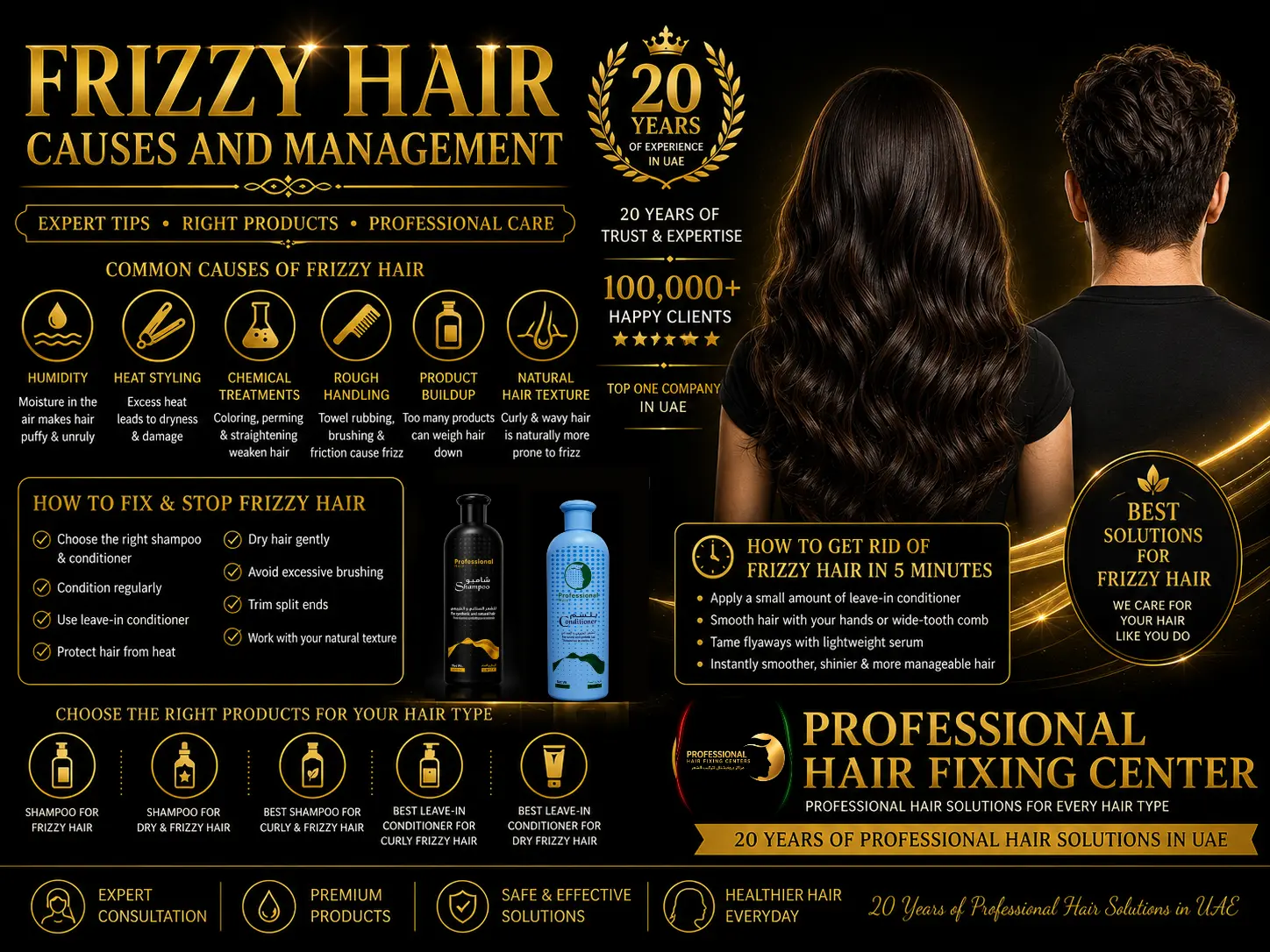
The most common frizzy hair causes include:
- Dry or dehydrated hair
- High humidity
- Damaged hair cuticles
- Excessive heat styling
- Frequent hair coloring or chemical treatments
- Overwashing
- Harsh shampoos
- Rough towel drying
- Excessive brushing
- Lack of conditioning
- Split ends and breakage
- Naturally curly or wavy hair texture
- Product buildup
- Sleeping on rough fabrics
- Incorrect styling techniques
Frizz is not necessarily a sign that your hair is unhealthy. Curly and wavy hair naturally tends to experience more visible frizz because of its structure. However, sudden or severe changes in texture may indicate that your hair-care routine needs adjustment.
Why Does Hair Become Frizzy?
To understand Frizzy Hair Causes and Management, it helps to understand the hair cuticle.
Each strand has an outer protective layer called the cuticle. Ideally, the cuticle lies relatively flat, helping the hair reflect light and appear smooth. When the cuticle becomes raised because of dryness, damage, friction, or environmental conditions, the surface becomes less uniform.
This can create the familiar:
- Puffy appearance
- Rough texture
- Flyaways
- Uncontrolled curls
- Dry-looking ends
- Uneven waves
- Lack of shine
Humidity can make the situation more noticeable because hair interacts with moisture in the air. This is particularly relevant for people who live in warm or humid climates.
The objective of frizz management is therefore not necessarily to eliminate every natural movement in the hair. Instead, the goal is to improve moisture balance, reduce unnecessary damage, protect the cuticle, and define the natural texture of the hair.
15 Common Frizzy Hair Causes
1. Dry Hair
Dryness is one of the most common causes of frizz. Hair that lacks sufficient moisture can feel rough and look dull. Dry strands are also more likely to develop static, flyaways, and an uneven appearance. Overwashing, hot water, excessive heat, and unsuitable hair products can all contribute to dryness. If your hair feels dry immediately after washing, consider using a gentler cleansing routine and a moisturizing conditioner.
2. Humidity
Humidity is a major contributor to frizz. When the surrounding air contains a lot of moisture, hair can absorb water from the environment. This can cause individual strands to swell and change shape. People with curly or wavy hair may notice this particularly strongly because their hair structure already has natural bends and curves. Instead of trying to fight humidity completely, use products designed to provide conditioning and help control the hair surface.
3. Heat Styling
Hair straighteners, curling irons, blow dryers, and other heated tools can contribute to dryness and damage when used frequently or at excessively high temperatures.
Repeated heat exposure can weaken the hair structure, particularly when the hair is already dry or chemically processed.
If you use heat regularly, always consider:
- Applying a heat-protectant product
- Using an appropriate temperature
- Avoiding repeated passes over the same section
- Allowing hair to dry appropriately before using certain heated tools
- Taking regular breaks from heat styling
4. Chemical Treatments
Hair coloring, bleaching, relaxing, perming, and other chemical processes can affect the hair structure. When the hair becomes more porous or damaged, it may lose moisture more quickly and become more vulnerable to frizz. If your hair has undergone chemical treatments, conditioning and gentle handling become especially important.
5. Overwashing
Washing your hair too frequently may remove natural oils that contribute to softness and manageability. However, the ideal washing frequency varies according to scalp type, hair texture, lifestyle, and product use. There is no universal number of washes that works for everyone. The important point is to avoid a routine that leaves your hair consistently dry, brittle, or rough.
6. Harsh Shampoo
Not every shampoo works equally well for every hair type. A strongly cleansing product may leave some dry, curly, or chemically treated hair feeling stripped. When choosing a shampoo for frizzy hair, look for a formula that suits your scalp while providing appropriate cleansing and conditioning support for your hair length. For particularly dry strands, people may prefer products marketed as moisturizing or designed for dry hair.
7. Rough Towel Drying
Rubbing wet hair vigorously with a regular towel can increase friction and contribute to tangling and breakage. Wet hair is more vulnerable to mechanical stress, so rough handling can make the hair appear more unruly. Instead of aggressively rubbing the hair, gently squeeze out excess water and pat or wrap the hair carefully.
8. Excessive Brushing
Brushing your hair repeatedly throughout the day can increase friction and disrupt natural texture. This can be particularly problematic for curly and wavy hair. Rather than brushing excessively, use a suitable wide-tooth comb or styling method appropriate for your hair type.
9. Split Ends
Split ends can make hair look rough and uneven. Once the end of a hair strand splits, conditioning products may temporarily improve its appearance, but they cannot permanently fuse the damaged strand back together. Regular trimming can help maintain a cleaner-looking shape and prevent severely damaged ends from making the hair appear increasingly unruly.
10. Product Buildup
Using numerous oils, creams, gels, sprays, and styling products can sometimes lead to buildup. Buildup can make hair feel heavy, dull, sticky, or difficult to style. If your hair suddenly feels coated or unusually difficult to manage, consider whether excessive product use is contributing to the problem.
11. Sleeping on Rough Fabrics
Nighttime friction can contribute to tangling, breakage, and frizz. People with curly or wavy hair may particularly notice changes after sleeping. Reducing friction during sleep and loosely protecting the hair can help maintain its shape and reduce unnecessary mechanical stress.
12. Frequent Coloring
Coloring itself is not automatically harmful, but repeated chemical processing can increase dryness and porosity. If your hair is frequently colored, focus on conditioning, gentle washing, heat protection, and careful handling.
13. Natural Hair Texture
Some frizz is simply part of your natural hair pattern. Curly and wavy hair naturally has bends that can make individual strands point in different directions. That means completely eliminating frizz may not be realistic—or even desirable. The better approach is to make your natural texture look conditioned, defined, and intentional.
14. Environmental Exposure
Sun exposure, wind, pollution, dry air, and humidity can all affect how hair looks and feels. Environmental exposure can contribute to dryness or increased roughness, especially when combined with frequent heat styling or chemical processing.
15. Incorrect Hair-Care Routine
Sometimes the problem is not one product but the overall routine. Using a strong cleanser, skipping conditioner, brushing aggressively, applying excessive heat, and then using heavy styling products may create a cycle where hair repeatedly becomes dry and difficult to manage. A simpler and more consistent routine can often produce better results.
How to Fix Frizzy Hair?
If you are wondering how to fix frizzy hair, start by addressing the cause rather than simply covering the frizz.
A practical routine can include:
- Choose a shampoo suitable for your scalp and hair type.
- Use conditioner after cleansing.
- Avoid very hot water.
- Handle wet hair gently.
- Reduce excessive heat styling.
- Apply a suitable leave-in conditioner.
- Use a heat protectant before heated tools.
- Avoid excessive brushing.
- Trim severely split ends.
- Protect your hair while sleeping.
- Adjust products according to your hair texture.
- Give your hair time to recover from excessive processing.
Consistency is more important than using a large number of products.
How to Stop Frizzy Hair?
You cannot always permanently stop frizzy hair, particularly if you naturally have curly or wavy hair or live in a humid environment. However, you can significantly improve frizz management by reducing the factors that make the hair surface rough or dehydrated.
A simple anti-frizz routine
Cleanse: Use a suitable shampoo without excessively stripping the hair.
Condition: Apply conditioner mainly through the lengths and ends.
Dry gently: Avoid aggressive towel rubbing.
Moisturize: Use a leave-in conditioner when your hair needs additional conditioning.
Protect: Apply heat protection before using a blow dryer or straightener.
Style carefully: Avoid repeated high-heat passes.
Maintain: Trim damaged ends and adjust your routine as your hair changes.
What Is the Best Shampoo for Frizzy Hair?
The best shampoo for frizzy hair depends on your scalp condition, hair texture, porosity, dryness, and styling routine. A good shampoo should cleanse the scalp without leaving the hair excessively dry. If your hair is dry and frizzy, a moisturizing shampoo may be more comfortable than an aggressively clarifying formula used frequently. For someone with curly hair, the best shampoo for curly and frizzy hair is generally one that supports the needs of curly hair without leaving the strands overly stripped.
Look for product characteristics such as:
- Gentle cleansing
- Moisturizing support
- Compatibility with your hair type
- Suitable formulation for frequent or occasional use
- Conditioning ingredients
- A formula that does not leave your hair feeling excessively dry
Remember that the “best” shampoo is not necessarily the most expensive product. It is the one that works well with your individual scalp and hair needs.
Shampoo for Dry and Frizzy Hair: What Should You Look For?
If you need a shampoo for dry and frizzy hair, prioritize a formula that cleans your scalp while helping your hair maintain a comfortable level of moisture. Dry hair may benefit from a routine that avoids excessive cleansing.
When comparing products, consider:
- Your scalp type
- How frequently you wash your hair
- Whether your hair is chemically treated
- Whether you have curly, wavy, or straight hair
- How dry your ends feel
- Whether you regularly use heat
A shampoo alone usually cannot solve severe frizz. Shampoo cleanses the hair and scalp, while conditioner and leave-in products can provide additional conditioning and manageability.
What Is the Best Shampoo for Curly and Frizzy Hair?
For curly hair, cleansing needs to be balanced carefully. Curly hair often feels drier through the lengths because natural scalp oils may not distribute down the bends of the hair as easily as they can on straight hair. The best shampoo for curly and frizzy hair should therefore be selected according to the person’s scalp and curl pattern rather than simply choosing a product labeled “anti-frizz.”
A useful curly-hair routine may include:
- Gentle cleansing
- Regular conditioning
- Leave-in conditioning
- Curl-friendly styling
- Minimal aggressive brushing
- Heat protection
- Appropriate drying techniques
If your scalp becomes oily or has significant buildup, occasional deeper cleansing may also be appropriate, depending on the product and your individual needs.
What Is the Best Leave-In Conditioner for Curly Frizzy Hair?
The best leave-in conditioner for curly frizzy hair depends on the curl pattern, porosity, thickness, and level of dryness. Curly hair often benefits from additional conditioning because the bends in the hair can make it more difficult for natural oils to travel from the scalp to the ends.
A suitable leave-in conditioner may help:
- Improve softness
- Reduce tangling
- Make curls easier to manage
- Improve the appearance of dry areas
- Support curl definition
- Reduce the appearance of flyaways
However, heavier is not always better. Fine curls may become weighed down by rich formulas, while thick or very dry curls may prefer more substantial conditioning.
Start with a small amount and increase only when necessary.
Best Leave-In Conditioner for Dry Frizzy Hair
When looking for the best leave-in conditioner for dry frizzy hair, focus on your hair’s actual needs rather than relying only on marketing labels. A good leave-in conditioner can provide additional conditioning between washes and make hair easier to detangle and style.
For dry hair, consider a product that provides:
- Moisturizing support
- Lightweight or rich conditioning according to your hair thickness
- Improved detangling
- Smooth-feeling finish
- Compatibility with your styling routine
Apply leave-in conditioner mainly through the lengths and ends unless the product specifically states that it can be applied to the scalp.
Frizzy Wavy Hair How to Manage It
Frizzy wavy hair can be particularly challenging because it sits between straight and curly textures. Wavy hair may look smooth in some areas and frizzy in others. Brushing it aggressively can separate the natural wave pattern and make the hair appear puffier.
For better wavy-hair management:
1. Avoid excessive brushing
Brush or comb when necessary, especially during detangling, rather than repeatedly brushing dry waves.
2. Condition regularly
A suitable conditioner can make wavy hair easier to manage.
3. Use lightweight leave-in products
Heavy products may flatten fine waves.
4. Scrunch gently
If you want to encourage your natural wave pattern, gently scrunching damp hair can help maintain texture.
5. Avoid unnecessary heat
Frequent straightening can dry the hair and alter the appearance of natural waves.
6. Allow waves to form naturally
Manipulating the hair too much while drying can increase frizz.
How to Get Rid of Frizzy Hair in 5 Minutes
If you need immediate improvement, you may be wondering how to get rid of frizzy hair in 5 minutes. You cannot repair damaged hair permanently in five minutes, but you can make frizz look more controlled quickly.
Try this five-minute emergency routine:
Minute 1: Lightly assess the hair
Identify whether the problem is dry ends, flyaways, puffiness, or general lack of definition.
Minute 2: Apply a small amount of leave-in conditioner
Use a small amount and distribute it through the frizzy areas. Avoid applying too much, particularly near the roots.
Minute 3: Smooth the surface
Use your hands or an appropriate comb to gently arrange the hair.
Minute 4: Tame visible flyaways
Use a very small amount of suitable styling product on your fingertips and lightly smooth the most noticeable flyaways.
Minute 5: Finish without overworking
Stop touching the hair once it looks controlled. Repeated touching can create additional friction and disrupt the style.
For a polished appearance before an event, this quick method can make a noticeable difference, but it should not replace a consistent hair-care routine.
Can a Hair Straightener Help With Frizzy Hair?
Yes, a hair straightener can temporarily make hair appear smoother by using heat to alter the hair’s shape. However, using a straightener too frequently or at excessively high temperatures can contribute to dryness and damage, which may eventually make frizz more difficult to manage.
If you use a straightener:
- Start with completely dry hair when the tool requires it.
- Apply heat protectant.
- Use an appropriate temperature.
- Work in manageable sections.
- Avoid repeated passes.
- Do not use high heat simply because it makes styling faster.
- Give your hair regular breaks from heat styling.
Best Hair Straightener for Frizzy Hair: What Matters?
People often search for the best hair straightener for frizzy hair, but the most important factor is not simply the brand or price.
Consider features such as:
- Adjustable temperature settings
- Even heat distribution
- Smooth plates
- Appropriate plate size for your hair length and thickness
- A temperature suitable for your hair type
- A design that allows controlled passes
Fine or damaged hair generally requires greater caution with heat than thick, coarse hair. The goal should be to use the lowest effective temperature rather than automatically choosing the highest setting. A straightener can improve the appearance of frizz temporarily, but it does not correct the underlying cause of damaged or dehydrated hair.
How to Use a Hair Straightener Without Making Frizz Worse
Correct technique matters.
Step 1: Prepare the hair
Start with clean, appropriately conditioned hair.
Step 2: Dry the hair properly
Do not use a straightener on wet hair unless the device is specifically designed for that purpose.
Step 3: Apply heat protection
A suitable heat-protectant product can help reduce heat-related damage.
Step 4: Divide the hair
Work with smaller sections instead of repeatedly going over large sections.
Step 5: Use controlled movements
Move the straightener smoothly from root area toward the ends without stopping in one place for too long.
Step 6: Finish with minimal product
If needed, use a lightweight finishing product to control flyaways.
Does Conditioner Help Frizzy Hair?
Yes. Conditioner can help improve the feel and manageability of frizzy hair. After shampooing, conditioner helps make the hair easier to detangle and can leave the lengths feeling smoother. For dry or curly hair, conditioning is particularly important because the hair may need more support against dryness and mechanical damage.
However, conditioner is not a permanent treatment for split ends or severe structural damage.
Lorem ipsum dolor sit amet, consectetur adipiscing elit. Ut elit tellus, luctus nec ullamcorper mattis, pulvinar dapibus leo.
Should You Use Hair Oil for Frizz?
Hair oils can help improve the appearance and feel of dry-looking hair by adding lubrication and shine. But using too much oil can make hair greasy, heavy, or difficult to style.
If you use an oil:
- Start with a very small amount.
- Apply primarily to the lengths and ends.
- Avoid overloading fine hair.
- Consider whether the product is compatible with your hairstyle.
- Do not assume oil replaces conditioner.
Oils can be useful as part of a routine, but they should complement—not replace—appropriate cleansing and conditioning.
How Does Humidity Affect Frizzy Hair?
Humidity can increase the appearance of frizz because hair interacts with moisture in the surrounding air. This is why hair that looks smooth indoors may become puffier or less defined after spending time outdoors in humid conditions.
The effect can be especially noticeable with curly and wavy textures.
To manage humidity-related frizz:
- Condition regularly.
- Use suitable leave-in products.
- Avoid excessive heat.
- Minimize unnecessary touching.
- Choose styling products designed for your hair texture.
- Protect the hair from excessive environmental exposure where practical.
The objective is not to make hair completely unaffected by humidity, but to improve its ability to maintain a smoother and more controlled appearance.
Lorem ipsum dolor sit amet, consectetur adipiscing elit. Ut elit tellus, luctus nec ullamcorper mattis, pulvinar dapibus leo.
Frizzy Hair Management for Curly Hair
Curly hair requires a slightly different approach because natural curl formation is part of its structure. Trying to make curly hair behave like naturally straight hair through constant brushing and heat can lead to more dryness and damage.
A curl-friendly routine may include:
Gentle cleansing: Clean the scalp according to its needs.
Conditioning: Keep the lengths conditioned.
Leave-in support: Use a suitable leave-in conditioner when additional moisture and manageability are needed.
Gentle detangling: Detangle carefully to reduce breakage.
Texture-friendly styling: Allow curls to form rather than repeatedly disturbing them.
Heat protection: Protect hair whenever heat tools are used.
Regular maintenance: Remove severely damaged ends when necessary.
Frizzy Hair Management for Straight Hair
Straight hair can also become frizzy, especially when it is dry or damaged.
For straight hair, frizz may appear as:
- Flyaways
- Rough ends
- Puffy sections
- Static
- Short broken hairs
- Uneven surface texture
A lightweight conditioner and leave-in product may be more appropriate than heavy curl creams. If the hair is fine, using too many products can make it look flat or greasy.
Frizzy Hair Management for Men
Frizzy hair is not limited to women. Men with short, medium, long, curly, or wavy hair can also experience frizz. Common causes include dryness, frequent shampooing, heat, environmental exposure, and natural hair texture.
A simple men’s anti-frizz routine can include:
- Use a suitable shampoo.
- Condition the hair regularly.
- Avoid very hot water.
- Dry gently.
- Use a small amount of leave-in conditioner if needed.
- Avoid excessive styling product.
- Protect hair from excessive heat.
- Trim damaged ends regularly.
Men with longer or curly hair may need more conditioning than someone with very short hair.
Morning Routine for Frizzy Hair
A simple morning routine can make frizz easier to manage.
For straight hair:
- Lightly smooth the hair.
- Apply a small amount of leave-in product if needed.
- Avoid excessive brushing.
- Use a finishing product only where required.
For wavy hair:
- Refresh the waves with a small amount of water or appropriate styling product.
- Scrunch gently.
- Avoid brushing dry waves repeatedly.
For curly hair:
- Refresh curls gently.
- Use a suitable leave-in conditioner or curl product when needed.
- Avoid excessive manipulation.
The key is to work with your natural texture rather than repeatedly forcing the hair into a different pattern.
Nighttime Hair Routine to Reduce Frizz
Your nighttime routine can influence how your hair looks the next morning.
Before sleeping:
- Detangle gently if necessary.
- Avoid sleeping with soaking-wet hair unless your routine and hair type support it.
- Consider loosely securing long hair.
- Avoid tight hairstyles that create excessive tension.
- Use a smooth sleeping surface if it works for you.
- Apply a small amount of suitable leave-in product if your hair needs additional conditioning.
The less unnecessary friction and tension your hair experiences, the easier it may be to manage.
Lorem ipsum dolor sit amet, consectetur adipiscing elit. Ut elit tellus, luctus nec ullamcorper mattis, pulvinar dapibus leo.
Common Mistakes That Make Frizzy Hair Worse
Mistake 1: Using too much product
More product does not always mean less frizz. Excess product can create buildup and weigh down the hair.
Mistake 2: Washing with very hot water
Very hot water may leave some hair feeling drier.
Mistake 3: Brushing curly hair when dry
This can disrupt curl definition and increase puffiness.
Mistake 4: Using maximum heat
Higher temperatures can increase the risk of heat damage.
Mistake 5: Skipping conditioner
If your hair is dry or curly, skipping conditioning may make manageability more difficult.
Mistake 6: Constantly touching your hair
Hands create friction and can disturb the hairstyle.
Mistake 7: Trying every viral hair hack
Not every trend works for every hair type. Your routine should be based on your hair’s actual needs.
Frizzy Hair: A Simple Weekly Care Routine
A consistent weekly routine can be more useful than repeatedly changing products.
Wash days
Use a shampoo suitable for your scalp and hair type.
Every wash
Follow with conditioner through the lengths and ends.
After washing
Gently remove excess water and use a suitable leave-in product if required.
Styling days
Use heat protection before heated tools.
Weekly assessment
Look at how your hair feels:
- Is it dry?
- Is it greasy?
- Is it weighed down?
- Is it tangled?
- Is the scalp comfortable?
- Are the ends damaged?
Adjust your routine according to these observations.
How Long Does It Take to Reduce Frizz?
The answer depends on the cause. If frizz is primarily caused by temporary dryness or poor styling, you may notice an improvement immediately after conditioning and styling. If the hair is significantly damaged, improving its appearance and manageability can take longer because existing structural damage cannot simply be reversed.
Healthy-looking hair generally requires ongoing care rather than a one-time treatment.
Remember:
Five minutes can improve the appearance of frizz. A consistent routine helps manage the underlying factors.
Lorem ipsum dolor sit amet, consectetur adipiscing elit. Ut elit tellus, luctus nec ullamcorper mattis, pulvinar dapibus leo.
Can Frizzy Hair Be Permanently Fixed?
There is no universal permanent cure for frizzy hair because some frizz is caused by natural hair texture, environmental humidity, and ongoing exposure.
However, you can often manage it effectively.
The most successful approach usually combines:
- Appropriate cleansing
- Regular conditioning
- Moisture management
- Gentle handling
- Heat protection
- Suitable styling products
- Regular trimming
- Protection against excessive environmental exposure
If hair is naturally curly or wavy, the goal should be healthy-looking definition rather than eliminating every strand of natural texture.
When Should You See a Hair Professional?
If your hair suddenly changes significantly, becomes extremely brittle, breaks extensively, or develops unusual scalp symptoms, consider speaking with a qualified healthcare professional or hair-care specialist. Professional advice can help identify whether the issue is related to routine, chemical processing, mechanical damage, or another underlying factor.
For cosmetic frizz alone, a professional stylist can also help assess:
- Hair texture
- Porosity
- Damage
- Appropriate haircut
- Suitable styling techniques
- Product compatibility
- Heat-styling practices
Frequently Asked Questions About Frizzy Hair
What is the main cause of frizzy hair?
How can I fix frizzy hair quickly?
For a quick improvement, apply a small amount of leave-in conditioner or suitable smoothing product, gently arrange the hair, and avoid excessive touching. This can improve appearance but does not repair underlying damage.
How to stop frizzy hair after washing?
Use a suitable conditioner, avoid rough towel drying, handle wet hair gently, apply an appropriate leave-in product, and minimize unnecessary heat.
What is the best shampoo for frizzy hair?
The best shampoo depends on your scalp and hair type. A suitable shampoo should cleanse effectively without leaving your hair excessively dry.
Is shampoo for dry and frizzy hair different from regular shampoo?
It can be. Products marketed for dry or frizzy hair often emphasize moisturizing or conditioning support. However, the ideal choice depends on your scalp and hair characteristics.
What is the best shampoo for curly and frizzy hair?
Choose a shampoo that cleanses your scalp while supporting the needs of your curl pattern and avoiding excessive dryness.
What is the best leave-in conditioner for curly frizzy hair?
The best leave-in conditioner depends on curl pattern, hair thickness, porosity, and dryness. Lightweight formulas may suit fine curls, while thicker hair may tolerate richer conditioning.
What is the best leave-in conditioner for dry frizzy hair?
Look for a leave-in conditioner that provides suitable conditioning and improves softness and manageability without making your hair excessively heavy.
How to get rid of frizzy hair in 5 minutes?
Use a small amount of leave-in conditioner or smoothing product, gently smooth the visible flyaways, arrange the hair, and stop manipulating it once it looks controlled.
Can a straightener remove frizz?
A straightener can temporarily make hair look smoother, but frequent or excessive heat may contribute to damage and dryness. Always use appropriate heat protection.
Is frizzy hair unhealthy?
Not necessarily. Frizz can be a normal characteristic of curly and wavy hair. However, sudden severe frizz accompanied by significant breakage or changes in hair condition may warrant professional evaluation.
Does oil remove frizz?
Hair oil may temporarily improve softness, shine, and the appearance of dry ends. It does not permanently repair damaged hair.
Frizzy Hair Causes and Management Quick Comparison
Cause | What You May Notice | Helpful Management |
Dryness | Rough, dull hair | Conditioning and moisture-focused routine |
Humidity | Puffy or expanded hair | Suitable leave-in and styling products |
Heat damage | Dry ends, breakage | Heat protection and reduced temperature |
Chemical processing | Porous or rough texture | Conditioning and gentle care |
Rough towel drying | Tangling and flyaways | Gentle drying |
Excessive brushing | Puffiness and breakage | Less manipulation |
Product buildup | Heavy or coated hair | Review product use and cleansing routine |
Split ends | Rough, uneven ends | Regular trimming |
Natural curls | Frizz around curl pattern | Curl-friendly styling |
Wavy texture | Uneven waves and flyaways | Lightweight conditioning and gentle styling |
A Simple 7-Step Anti-Frizz Routine
If you want a straightforward approach, follow these seven steps:
1. Choose the right shampoo
Select a shampoo based on your scalp and hair needs rather than simply choosing the most popular product.
2. Never skip conditioning
Apply conditioner to the lengths and ends after shampooing.
3. Dry gently
Avoid aggressively rubbing your hair with a towel.
4. Add leave-in conditioning
Use a suitable leave-in conditioner when your hair needs additional softness or manageability.
5. Protect from heat
Use heat protection before straightening, curling, or blow drying.
6. Reduce unnecessary manipulation
Avoid constantly brushing, touching, or restyling the hair.
7. Maintain damaged ends
Trim severely split or damaged ends when necessary.
This routine is simple, but consistency is what makes it useful.
Final Thoughts: Expert Frizzy Hair Solutions in the UAE
Understanding Frizzy Hair Causes and Management is the first step toward creating a hair-care routine that works for your specific hair type. Frizz can result from dryness, humidity, heat styling, chemical treatments, friction, product buildup, and natural hair texture. Because every person’s hair is different, there is no single product or treatment that works for everyone. If you are wondering how to fix frizzy hair?, start with the fundamentals: gentle cleansing, regular conditioning, careful drying, suitable leave-in products, and proper heat protection. If you want to know how to stop frizzy hair, focus on reducing the factors that leave your hair dry, damaged, or difficult to manage. For people with frizzy wavy hair or naturally curly textures, working with the natural pattern of the hair can often be more effective than repeatedly straightening or brushing it. Choosing the right shampoo for frizzy hair, shampoo for dry and frizzy hair, or best shampoo for curly and frizzy hair should also depend on your scalp condition, hair texture, and level of dryness.
Similarly, the best leave-in conditioner for curly frizzy hair or best leave-in conditioner for dry frizzy hair should provide appropriate conditioning and manageability without making your hair feel excessively heavy or greasy. If you need a quick styling solution, learning how to get rid of frizzy hair in 5 minutes can help temporarily improve the appearance of flyaways and puffiness. However, long-term frizz management depends on consistent hair care and protecting the hair from unnecessary damage. For those who prefer straight hairstyles, selecting the best hair straightener for frizzy hair is only one part of the process. Using an appropriate temperature, applying heat protection, and limiting excessive heat exposure are equally important.
Professional Frizzy Hair Solutions in the UAE
If you are looking for professional support for managing frizzy, dry, wavy, or difficult-to-control hair, Professional Hair Fixing Center provides professional hair-care and hair-fixing solutions in the UAE. The center also offers suitable shampoo and conditioner options to support better hair care and manageability. With 20 years of experience in the UAE, Professional Hair Fixing Center has built its reputation by providing personalized hair solutions for different hair concerns. Its professional approach focuses on helping clients choose suitable solutions based on their hair condition, appearance, texture, and individual requirements. Whether your concern is frizzy hair, dry hair, wavy hair, hair thinning, or overall hair manageability, professional guidance can help you understand which products and care techniques are appropriate for your needs. For better results, remember that managing frizz is not simply about making hair look straight. It is about maintaining a healthy-looking appearance, improving manageability, reducing unnecessary damage, and choosing the right products for your individual hair type.
Professional Hair Fixing Center — 20 Years of Professional Hair Solutions in the UAE.
 EN
EN  AR
AR