Damaged hair is one of the most common hair concerns for both men and women. Hair can become dry, weak, rough, frizzy, tangled, brittle, or prone to breakage because of heat styling, bleaching, coloring, chemical treatments, excessive brushing, tight hairstyles, environmental exposure, and improper hair-care practices.
If you are searching for how to fix damaged hair, the first step is to understand the type and cause of the damage. Mild dryness and roughness can often be managed with a consistent hair-care routine, while severe breakage, extensive chemical damage, thinning, or hair loss may require a professional hair solution.
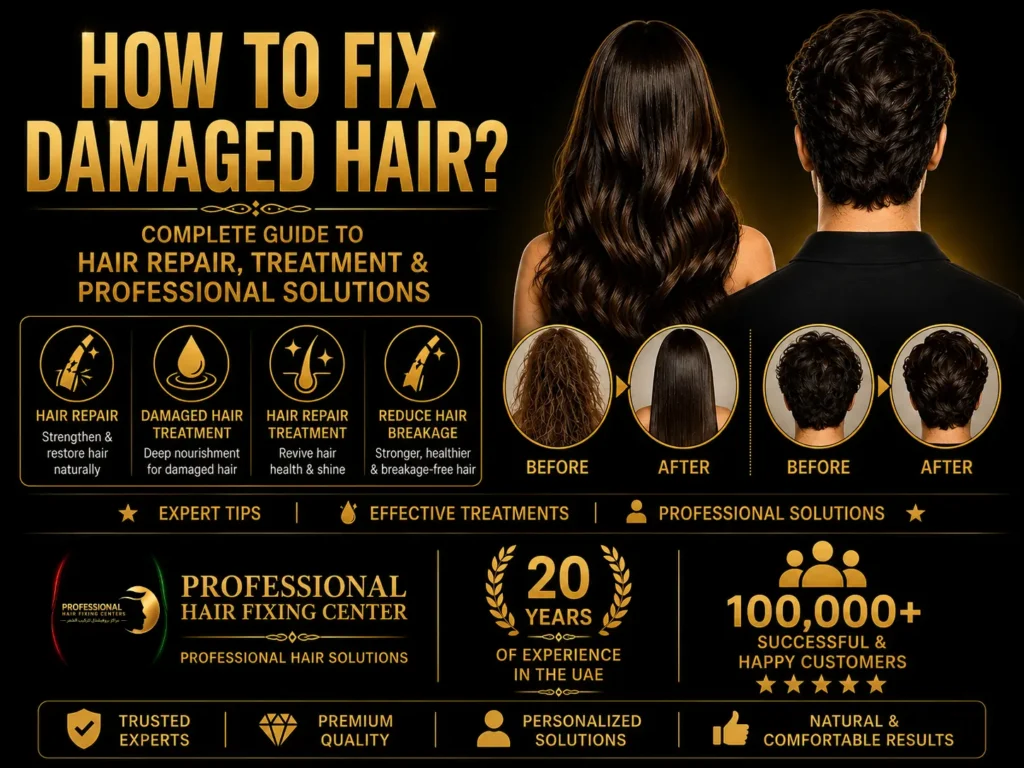
Professional Hair Fixing Center provides professional hair solutions in the UAE for people dealing with damaged, thinning, or missing hair. With 20 years of Working in the UAE and more than 100,000 successful and satisfied customers, the company has extensive experience in helping clients find suitable solutions for different hair concerns.
It is important to understand that damaged hair cannot always be completely restored to its original biological condition. The visible hair shaft is non-living tissue, so severely damaged sections cannot regenerate themselves. However, the appearance, softness, manageability, and protection of existing hair can often be improved with appropriate care. When natural hair is severely damaged, thin, or missing, professional hair fixing solutions can offer another option for improving overall hair appearance.
This comprehensive guide explains how to repair damaged hair, the most common causes of hair damage, effective hair repair treatment options, ways to prevent hair breakage, and when professional hair solutions may be appropriate.
How to Fix Damaged Hair?
The best way to fix damaged hair is to identify the cause, stop or reduce ongoing damage, improve conditioning and protection, and use a hair-care or professional solution appropriate for your condition.
For mild damage, you can begin with a simple routine that includes gentle cleansing, regular conditioning, reduced heat styling, careful detangling, and an appropriate hair repair treatment. For more severe damage, especially when hair is breaking extensively or there is significant thinning or hair loss, simply changing shampoo may not be enough. A professional consultation can help determine whether you need a specialized hair treatment, trimming, or a professional hair solution.
8 Steps to Repair Damaged Hair
- Identify the cause of the damage.
- Reduce heat styling.
- Limit unnecessary chemical treatments.
- Use a suitable shampoo and conditioner.
- Apply an appropriate hair repair treatment.
- Handle wet and dry hair gently.
- Trim severely split or damaged ends.
- Consider professional hair solutions for severe damage or hair loss.
The right approach depends on whether your main concern is dryness, split ends, chemical damage, heat damage, mechanical breakage, thinning, or hair loss.
What Is Damaged Hair?
Damaged hair is hair that has experienced physical, chemical, or environmental stress that affects its structure, appearance, texture, flexibility, or strength.
The outer layer of the hair is called the cuticle. It helps protect the inner parts of the hair shaft. Repeated exposure to damaging factors can affect the cuticle and make the hair feel rougher, drier, and more difficult to manage.
Hair damage can develop gradually. Someone who frequently colors or straightens their hair may not notice major changes after one treatment, but repeated processing can gradually increase dryness, roughness, and breakage.
Common Signs of Damaged Hair
You may have damaged hair if you notice:
- Rough or coarse texture
- Dryness
- Frizz
- Split ends
- Increased tangling
- Dull appearance
- Reduced elasticity
- Hair that breaks easily
- Uneven-looking ends
- Excessive flyaways
- Difficulty styling the hair
- Hair that feels weaker than before
The presence of one symptom does not necessarily mean severe damage. For example, hair may feel dry because it needs more conditioning, while repeated snapping and extensive split ends may indicate more significant structural damage.
What Does Damaged Hair Look Like?
Damaged hair can look different depending on the cause and severity. Dry damaged hair may appear dull and frizzy. Chemically processed hair may feel rough or unusually porous. Heat-damaged hair may become brittle and difficult to style. Mechanical damage may appear as short broken hairs around the hairline and throughout the lengths.
Signs to Look For:
Split ends: The end of a strand divides into two or more sections.
Breakage: Hair snaps somewhere along the shaft instead of remaining intact.
Frizz: Damaged or raised cuticles can contribute to an uneven, frizzy appearance.
Tangles: Rougher hair surfaces can increase friction between strands.
Loss of shine: Damaged hair may reflect light less evenly.
Reduced elasticity: Weakened hair may not return to its original shape as easily after stretching.
If several of these signs occur together, reviewing your hair-care routine can help identify potential sources of damage.
What Causes Hair Damage?
Understanding the cause is essential when learning how to repair damaged hair. If the source of damage continues, even an effective treatment may provide only temporary improvement.
Heat Styling
Frequent high-temperature styling is a common cause of hair damage.
Heat can come from:
- Hair straighteners
- Curling irons
- Hot brushes
- Blow dryers
- Heated styling tools
Repeatedly exposing the same hair sections to high temperatures can increase dryness and brittleness.
You do not necessarily have to stop using heat completely. Instead, reduce the temperature when possible, limit how frequently you use heated tools, use heat protection, and avoid repeatedly applying heat to the same section.
Chemical Treatments
Chemical processing can alter the structure and condition of hair.
Common chemical services include:
- Bleaching
- Permanent coloring
- Chemical straightening
- Relaxing
- Perming
Bleaching can be particularly demanding because it removes natural pigment through a chemical process and can weaken the hair structure.
If you regularly use chemical treatments, try to avoid repeatedly processing already weakened lengths. Professional guidance can also help you determine how frequently your hair can reasonably undergo chemical services.
Excessive Washing
Washing your hair is important for maintaining scalp hygiene, but your washing routine should suit your scalp and hair type.
There is no universal number of washes that is ideal for everyone. Someone with an oily scalp may need more frequent cleansing, while someone with dry or textured hair may wash less frequently.
If your hair consistently feels excessively dry after washing, consider whether your shampoo, washing frequency, water temperature, or conditioning routine needs adjustment.
Harsh Hair Products
Some products may not be suitable for every hair type.
Using products that leave your hair feeling excessively dry, rough, or difficult to manage may contribute to poor hair condition.
Instead of choosing products based solely on marketing claims, consider:
- Your hair texture
- Your scalp condition
- Whether your hair is chemically treated
- Whether your hair is dry or oily
- Whether you experience breakage
- How your hair responds to the product
Mechanical Damage
Not all hair damage comes from chemicals or heat.
Everyday handling can also contribute to hair breakage.
Common examples include:
- Aggressive brushing
- Pulling through knots
- Tight ponytails
- Tight buns
- Rough towel drying
- Excessive manipulation
- Repeated friction
- Sleeping with heavily tangled hair
Mechanical damage can be reduced by treating your hair gently and minimizing unnecessary tension.
Environmental Damage
The environment can also contribute to changes in hair condition.
Potential factors include:
- Strong sunlight
- Chlorinated swimming pools
- Salt water
- Dry air
- Humidity
- Wind
- Pollution
Environmental exposure may not be the primary cause of damage, but it can add to the effects of heat, chemical processing, and mechanical stress.
How to Repair Damaged Hair at Home?
If your hair has mild or moderate dryness and damage, you can begin with a consistent home-care routine.
The goal is not to find one miracle product. Instead, focus on reducing further damage and improving the condition of the existing hair.
1. Use a Suitable Shampoo
Choose a shampoo based on your scalp and hair needs.
When washing:
- Thoroughly wet your hair.
- Apply shampoo primarily to the scalp.
- Massage gently with your fingertips.
- Rinse thoroughly.
- Allow the shampoo to rinse through the lengths without aggressively scrubbing them.
- Follow with conditioner.
Avoid using excessive force when washing.
2. Condition Your Hair After Washing
The conditioner is particularly useful for dry or damaged hair because it can improve softness and manageability.
Apply conditioner to the lengths and ends, particularly if those areas are dry.
Conditioning can also make detangling easier, which may reduce mechanical stress during brushing.
3. Use a Hair Repair Treatment
A hair repair treatment can help improve the feel and appearance of damaged hair.
Different products have different purposes. Some primarily provide conditioning and moisture, while others are designed for chemically treated or weakened hair.
The best option depends on the cause of your damage.
For example:
- Dry hair may need more conditioning.
- Chemically processed hair may benefit from products designed for treated hair.
- Hair that breaks easily may require a combination of gentle handling, conditioning, and strengthening-focused care.
Follow product instructions and avoid assuming that using more product will automatically produce better results.
4. Deep Condition Regularly
A deep-conditioning treatment can provide more intensive conditioning than a standard conditioner.
Depending on the product and your hair condition, using a deep treatment periodically may improve softness and manageability.
Apply the product according to the manufacturer’s instructions and concentrate on the areas that need the most conditioning.
5. Reduce Heat Styling
Reducing heat exposure is one of the most important steps in a damaged-hair routine.
If you use heated tools:
- Choose the lowest effective temperature.
- Use an appropriate heat protectant.
- Avoid repeated passes.
- Do not keep heat on one section for too long.
- Give your hair breaks between styling sessions.
If possible, allow your hair to partially air-dry before using a blow dryer.
6. Detangle Carefully
Do not force a brush through severe knots.
Instead:
- Start at the ends.
- Gradually move upward.
- Work through small sections.
- Use conditioner or a suitable detangling product when appropriate.
- Avoid aggressive pulling.
This can help reduce unnecessary mechanical stress.
7. Trim Severely Split Ends
Once a hair end has split, products cannot permanently restore the original structure of that split section. Trimming removes the visibly damaged portion. A haircut or trim does not biologically “repair” the hair, but it can improve the appearance and manageability of damaged ends.
What Is the Best Damaged Hair Treatment?
There is no single damaged hair treatment that is suitable for everyone.
The best approach depends on:
- Cause of damage
- Hair texture
- Severity of damage
- Amount of breakage
- Chemical-processing history
- Heat exposure
- Overall hair condition
Moisturizing Treatments
Moisturizing and conditioning products can help when hair feels:
- Dry
- Rough
- Frizzy
- Difficult to manage
- Difficult to detangle
They can improve the feel and appearance of the hair without requiring major changes to the hairstyle.
Strengthening-Focused Treatments
Some products are designed to support the feel of weakened hair and may contain proteins or other conditioning ingredients.
These can be useful for certain types of damaged hair.
However, more treatment is not always better. Follow the product’s instructions and monitor how your hair responds.
Professional Hair Repair Treatments
If your hair has severe damage from bleaching, chemical treatments, or repeated heat styling, a professional assessment may be useful.
A professional can consider:
- Hair texture
- Visible damage
- Breakage
- Split ends
- Chemical-processing history
- Hair density
- Your desired appearance
This can help determine whether the focus should be on conditioning, strengthening, trimming, reducing chemical services, or another professional solution.
Can Hair Fixing Help With Severely Damaged or Thinning Hair?
Hair repair and hair fixing are not exactly the same thing.
A hair repair treatment focuses on improving the condition and appearance of existing hair.
Hair fixing is a professional hair solution that can help improve the visible appearance of areas affected by significant thinning, hair loss, insufficient hair coverage, or severely compromised natural hair. When someone has mild dryness, a normal hair-care routine may be enough. But when hair is severely damaged or there is substantial thinning, continuing to apply masks and conditioners may not address the person’s main concern. This is where professional consultation can be useful.
Professional Hair Fixing Center: Hair Solutions in the UAE
Professional Hair Fixing Center is a professional hair solutions company in the UAE with 20 years of experience in the UAE and more than 100,000 successful and satisfied customers.
The company provides professional hair solutions for people dealing with different hair concerns, including damaged, thinning, and missing hair. With two decades of experience, the center understands that every client has different hair characteristics, expectations, lifestyle requirements, and desired results. Rather than assuming one solution is suitable for everyone, a professional consultation can help determine which option is appropriate for the individual’s situation.
20 Years of Experience in the UAE
Experience is an important consideration when choosing a professional hair solutions provider.
Professional Hair Fixing Center has 20 years of experience in the UAE, giving the company extensive experience working with clients with different hair concerns.
This long-standing experience can help clients understand their available options and make a more informed decision about their hair solution.
More Than 100,000 Successful and Satisfied Customers
Professional Hair Fixing Center has served more than 100,000 successful and satisfied customers. This extensive customer experience reflects the company’s long-term presence in the UAE hair solutions industry and its focus on providing personalized solutions.
Personalized Hair Solutions
Hair concerns are not identical for every individual.
Two people may both describe their hair as “damaged,” but one may have dry ends from heat styling while another may have severe thinning or significant hair loss.
The appropriate solution can therefore be different. A professional consultation allows the client’s specific situation and desired appearance to be considered before selecting a solution.
What Professional Hair Solutions Can Address?
Professional hair solutions may be considered for people dealing with:
- Severe hair thinning
- Significant hair loss
- Hair breakage
- Reduced hair coverage
- Damaged natural hair
- Difficulty styling existing hair
- Areas where natural hair is insufficient
- Appearance concerns caused by hair loss
The purpose is to provide a suitable solution based on the person’s condition and expectations.
A professional assessment is important because not every hair solution is suitable for every person.
How Does Hair Repair Differ From Hair Fixing?
Understanding this difference can help you choose the right approach.
Hair Repair | Professional Hair Fixing |
Focuses on existing hair | Focuses on the overall visible appearance |
Can improve softness and manageability | Can provide a solution for insufficient hair coverage |
Often involves home or professional treatments | Generally involves professional assessment |
Useful for dryness and certain types of damage | Can be considered for significant thinning or hair loss |
Helps protect existing hair | Can provide an alternative appearance when natural hair is insufficient |
Someone with mildly dry hair may not need hair fixing.
Someone with extensive hair loss may need a solution beyond conventional hair repair products.
How to Fix Damaged Hair From Bleaching?
Bleaching can cause significant stress to the hair because it changes the hair’s pigment and can weaken its structure.
If your hair has become damaged after bleaching, focus on reducing further stress.
Reduce Additional Bleaching
Avoid repeatedly applying bleach to already weakened sections.
Discuss your desired color and maintenance requirements with a professional before undertaking additional chemical services.
Increase Conditioning
Use conditioner consistently and consider an appropriate deep-conditioning treatment.
Reduce Heat
Avoid combining frequent bleaching with excessive straightening, curling, or high-temperature blow-drying.
Handle Hair Carefully
Bleached hair can be fragile. Avoid aggressive brushing and tight hairstyles.
Trim Damaged Ends
If your ends are severely split or breaking, trimming can remove the most damaged portions.
Consider Professional Hair Solutions
If bleaching has caused severe breakage or your hair has become significantly thinner, professional consultation can help you explore available solutions.
Professional Hair Fixing Center can provide professional hair solutions for clients whose hair concerns go beyond simple dryness or minor damage.
How to Fix Heat-Damaged Hair?
Heat-damaged hair may feel dry, rough, brittle, or difficult to manage.
The first step is to reduce the source of the damage.
Reduce Styling Frequency
Give your hair regular breaks from straighteners, curling irons, and other heated tools.
Lower the Temperature
Use the lowest temperature that can achieve your desired style.
Use Heat Protection
Apply a suitable heat-protective product according to its instructions.
Avoid Repeated Passes
Do not repeatedly run a straightener over the same section.
Improve Conditioning
Use regular conditioner and consider a suitable repair or deep-conditioning treatment.
Trim Severe Damage
If the ends are severely split or breaking, trimming may be necessary.
No heat-protection product should be treated as permission to use unlimited heat. Reducing heat exposure remains the most important preventive measure.
How to Fix Dry and Damaged Hair?
Dryness and damage often occur together.
If your hair is both dry and damaged, consider the following routine:
- Use a suitable shampoo.
- Condition after washing.
- Deep-condition periodically.
- Reduce heat styling.
- Avoid unnecessary chemical treatments.
- Use a suitable leave-in product if needed.
- Detangle carefully.
- Reduce friction.
- Trim severely damaged ends.
You should also evaluate whether your current products are appropriate for your hair type.
How to Stop Hair Breakage?
Hair breakage happens when a hair strand snaps somewhere along its length.
It is different from normal hair shedding.
To reduce breakage:
- Reduce excessive heat.
- Limit chemical processing.
- Condition consistently.
- Detangle gently.
- Avoid tight hairstyles.
- Reduce friction.
- Avoid aggressive towel drying.
- Protect your hair while sleeping.
- Trim severely split ends.
- Avoid repeatedly manipulating fragile sections.
If breakage is extensive or continues despite improving your routine, professional assessment may be appropriate.
Hair Breakage vs. Hair Loss
These terms are often confused.
Hair Breakage
Breakage occurs when the hair shaft snaps.
You may notice short broken hairs, uneven ends, or increased split ends.
Hair Loss or Shedding
Hair shedding involves complete strands being released from the follicle.
Persistent or unusual hair loss can have many possible causes and may require evaluation by an appropriate healthcare professional.
Professional hair fixing solutions may address the visible appearance of thinning or insufficient hair coverage, but the underlying cause of hair loss should be appropriately evaluated when necessary.
How Long Does It Take to Repair Damaged Hair?
There is no universal recovery timeline.
The time required depends on:
- Severity of damage
- Cause of damage
- Hair texture
- Frequency of chemical treatments
- Heat exposure
- Hair-care routine
- Amount of existing breakage
Conditioning products may improve softness and manageability relatively quickly.
However, severely damaged hair cannot biologically regenerate. The visible hair shaft is non-living tissue.
This means that the long-term strategy should focus on:
- Improving the condition of existing hair
- Preventing additional damage
- Trimming severely damaged sections
- Protecting new growth
- Using suitable professional solutions when needed
Can Completely Damaged Hair Be Repaired?
Completely damaged hair cannot always be returned to its original biological state.
Treatments can improve:
- Softness
- Shine
- Manageability
- Smoothness
- Appearance
- Conditioning
But if the hair shaft has severe structural damage, no topical treatment can recreate the original biological structure.
This is why preventing additional damage is so important.
If a person has severe hair damage together with thinning or significant hair loss, a professional hair solution may be worth considering.
Why Choose a Professional Hair Fixing Center in the UAE?
Choosing a professional hair solutions provider is an important decision.
Professional Hair Fixing Center stands out through its long experience in the UAE and extensive customer history.
20 Years of UAE Experience
The center has 20 years of experience in the UAE, providing professional hair solutions to clients with different hair concerns.
This experience provides a strong foundation for understanding the needs of clients in the region.
100,000+ Successful and Satisfied Customers
The company has served more than 100,000 successful and satisfied customers.
This extensive customer base reflects years of practical experience in providing hair-related solutions.
Professional Approach
Every client can have different hair characteristics and expectations.
A professional approach focuses on understanding the client’s needs before recommending an appropriate solution.
Solutions for Different Hair Concerns
Professional Hair Fixing Center provides hair solutions for clients dealing with concerns such as:
- Hair thinning
- Hair loss
- Damaged hair
- Hair breakage
- Reduced hair coverage
- Styling difficulties caused by insufficient hair
Frequently Asked Questions About How to Fix Damaged Hair
What Is the Fastest Way to Fix Damaged Hair?
The fastest way to improve the appearance and manageability of damaged hair is to stop ongoing damage, reduce heat and chemical processing, condition regularly, use a suitable hair repair treatment, and trim severely damaged ends when necessary. Severely damaged hair cannot always be completely restored to its original biological condition.
How Can I Repair Damaged Hair Naturally?
Focus on gentle hair care, regular conditioning, reduced heat, limited chemical processing, careful detangling, and protection from unnecessary friction. “Natural” does not automatically mean better, so choose products and methods based on your hair’s actual needs.
Can Damaged Hair Become Healthy Again?
New hair can grow healthy when damaging habits are controlled. Existing damaged hair can often be made softer, smoother, and easier to manage, but severely damaged sections cannot biologically regenerate. Trimming may be necessary when damage is extensive.
What Is the Best Hair Repair Treatment?
The best hair repair treatment depends on the type and severity of damage. Dry hair may benefit from conditioning treatments, while chemically processed or fragile hair may require a combination of conditioning, strengthening-focused products, reduced chemical processing, and professional advice.
How Do I Stop Hair Breakage?
Reduce heat and chemical processing, condition regularly, detangle gently, avoid tight hairstyles, reduce friction, and trim severely damaged ends. If breakage continues or is extensive, consider professional assessment.
Does Cutting Damaged Hair Help?
Yes. Cutting or trimming removes split and severely damaged sections and can improve the appearance and manageability of the hair. However, trimming does not repair the biological structure of the remaining hair.
Can Heat-Damaged Hair Be Repaired?
Heat-damaged hair can often be improved in appearance and manageability with conditioning and protective care. However, severe structural damage cannot be completely reversed. Reducing heat exposure is essential to prevent additional damage.
Can Bleached Hair Be Repaired?
Bleached hair can often be conditioned and made more manageable, but severe structural damage cannot be completely reversed. Reduce additional chemical processing, limit heat, condition regularly, and handle the hair gently.
Can Hair Fixing Help With Hair Damage?
Hair fixing is different from conventional hair repair. It may be considered when severe damage is accompanied by thinning, hair loss, or insufficient hair coverage. Professional Hair Fixing Center provides professional hair solutions based on individual hair concerns.
Is a Professional Hair Fixing Center Experienced?
Yes. According to the company’s provided business information, Professional Hair Fixing Center has 20 years of experience in the UAE and has successfully served more than 100,000 customers.
Who Should Consider a Professional Hair Solution?
People experiencing significant thinning, hair loss, insufficient hair coverage, severe damage, or persistent hair concerns may benefit from a professional consultation. The appropriate solution depends on the individual’s condition and expectations.
Is Hair Fixing the Same as Hair Replacement?
Hair fixing and hair replacement can refer to professional approaches for improving the appearance of insufficient or missing hair, but terminology and techniques can vary between providers. A consultation is the best way to understand which specific solution is appropriate.
Final Thoughts: How to Fix Damaged Hair?
If your hair is mildly dry or damaged, begin with a simple and consistent routine: use an appropriate shampoo, condition regularly, reduce heat styling, limit chemical processing, detangle gently, and apply a suitable hair repair treatment. If your hair has extensive breakage, severe chemical damage, significant thinning, or hair loss, traditional hair-care products may not provide the type of solution you need. Professional assessment can help you understand your options.
Professional Hair Fixing Center provides professional hair solutions in the UAE and has 20 years of experience in the UAE with more than 100,000 successful and satisfied customers. The company’s experience allows it to provide personalized solutions for clients with different hair concerns. Whether your priority is improving damaged hair, reducing the appearance of thinning, addressing insufficient hair coverage, or finding a professional hair solution, the right approach should be based on your individual hair condition and goals. The key is to avoid treating every hair concern in the same way. Hair repair can help improve the condition and appearance of existing hair, while professional hair fixing solutions may provide an alternative for people experiencing significant thinning, hair loss, or insufficient coverage.
 EN
EN  AR
AR